UTM Tracking for Partnerize: How to Build and Validate Affiliate Campaign Links
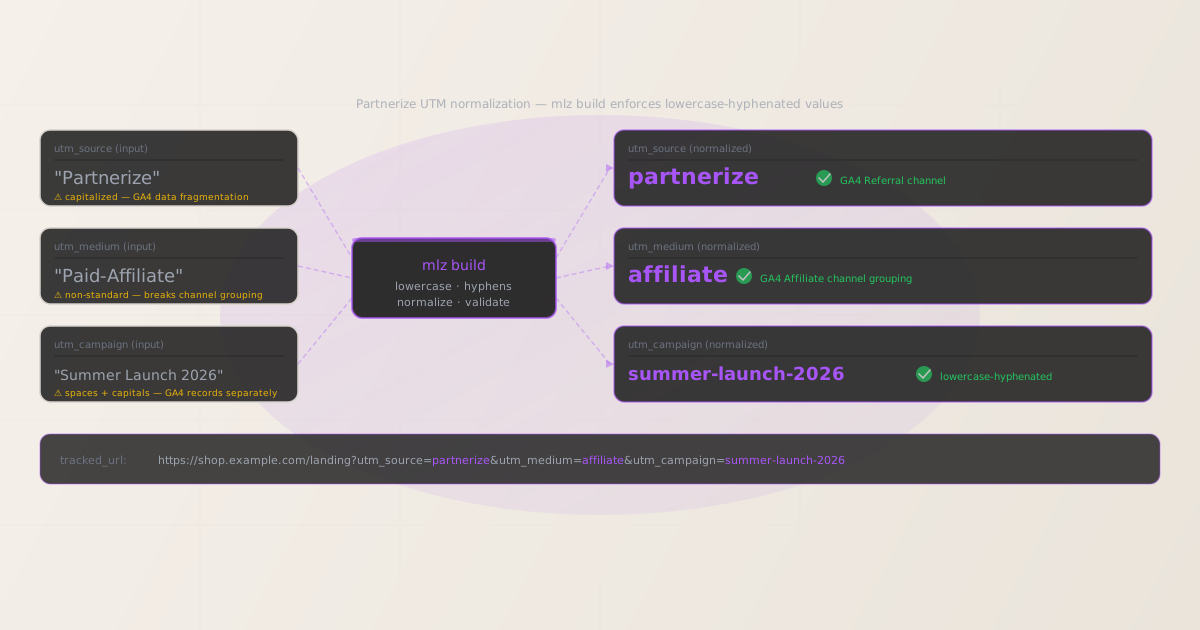
To add UTM tracking for Partnerize, add UTM parameters to the advertiser destination URL you configure in your Partnerize programme settings — not to the publisher-facing affiliate links Partnerize generates. GA4 reads UTM parameters from the landing page URL after Partnerize’s prf.hn tracking redirect delivers the visitor to your configured destination. Use MissingLinkz mlz build to generate a normalized destination URL with consistent, lowercase-hyphenated UTM values and mlz check to confirm the Partnerize redirect chain delivers those parameters intact to your landing page. The silent failure mode specific to enterprise-scale Partnerize deployments: large advertiser programmes often involve multiple internal teams — regional marketing, agency partners, performance marketing — each entering destination URLs manually into Partnerize. Without automated normalization, casing variations like utm_source=Partnerize versus utm_source=partnerize quietly fragment GA4’s Affiliate channel reporting across every active programme. mlz build enforces lowercase-hyphenated output at generation time, eliminating this class of attribution error before it reaches Partnerize’s advertiser configuration.
How Partnerize’s tracking architecture interacts with UTM parameters
Partnerize (formerly Performance Horizon) is an enterprise partner management platform used by major global brands in retail, travel, financial services, and subscription industries. The platform connects advertisers with publishers — content sites, cashback networks, comparison engines, coupon affiliates, and loyalty programmes — and provides advanced partner recruitment, contracting, and performance reporting capabilities. Partnerize operates at enterprise scale and is used by some of the largest global affiliate programmes.
When a publisher promotes a Partnerize programme via their affiliate link, the click routes through Partnerize’s prf.hn tracking domain, which records the click event for commission attribution and partner performance reporting, then redirects the browser to the advertiser’s configured destination URL. Partnerize’s click attribution system operates entirely separately from GA4 UTM tracking and does not depend on or interfere with UTM parameters on the destination URL.
The consequence for UTM tracking: UTM parameters belong on the destination URL you configure in Partnerize’s campaign management interface, not on the publisher-facing tracking links that Partnerize generates via prf.hn. Paste the UTM-tagged destination URL generated by mlz build into the destination URL field when setting up Partnerize campaigns. For a broader explanation of how affiliate network redirect chains interact with UTM parameters, see the UTM tracking for developers guide.
Building Partnerize destination URLs with mlz build
At enterprise scale, Partnerize programmes are frequently managed by teams across multiple regions, agencies, or internal departments. Each team entering destination URLs manually introduces the risk of casing inconsistencies: utm_source=Partnerize (capitalized) from a regional team, utm_source=partnerize (correct) from another, and utm_source=PartnerizeNetwork from a third. GA4 is case-sensitive and records these as separate sources, fragmenting Affiliate channel reporting and making cross-programme attribution analysis unreliable. mlz build eliminates this by enforcing lowercase-hyphenated values from structured input regardless of what the operator types.
The standard naming convention for Partnerize programmes is utm_source=partnerize, utm_medium=affiliate, and utm_campaign=[programme-name-or-season]. Use utm_content to differentiate between creative types, publisher categories, or regional programmes within the same campaign. For large enterprises running Partnerize across multiple geographies, use a region-specific source value such as utm_source=partnerize-uk or utm_source=partnerize-us to enable geographic attribution breakdowns in GA4.
$ mlz build \
  --url "https://shop.example.com/landing" \
  --source "partnerize" \
  --medium "affiliate" \
  --campaign "summer-launch-2026" \
  --content "content-publishers" \
  --validate

{
  "tracked_url": "https://shop.example.com/landing?utm_source=partnerize&utm_medium=affiliate&utm_campaign=summer-launch-2026&utm_content=content-publishers",
  "params": {
    "utm_source": "partnerize",
    "utm_medium": "affiliate",
    "utm_campaign": "summer-launch-2026",
    "utm_content": "content-publishers"
  },
  "destination_url": "https://shop.example.com/landing",
  "link_id": "lnk_pz_s26_cp",
  "campaign_id": "cmp_summer-launch-2026",
  "stored": true,
  "created_at": "2026-07-04T10:00:00.000Z"
}
The tracked_url value is what you paste into the destination URL field in Partnerize’s campaign management interface when configuring your programme. For multi-geography programmes, generate a distinct destination URL per region using a region-specific source or content value:
mlz build --url "https://shop.example.com/uk/landing" --source "partnerize-uk" --medium "affiliate" --campaign "summer-launch-2026" --content "cashback"
For naming conventions and how consistent casing prevents GA4 data fragmentation across affiliate sources, see the UTM naming conventions guide. To generate destination URLs programmatically for large Partnerize campaign catalogues across multiple programmes via the REST API, see how to build UTM links programmatically.
Validating the Partnerize prf.hn redirect chain with mlz check
Once you have a UTM-tagged destination URL, validate it end-to-end with mlz check before entering it into Partnerize’s campaign management interface. mlz check follows the complete redirect chain from your destination URL, confirms the server responds with a 200 status code, and verifies that query parameters are not stripped at any hop. Run this before any Partnerize campaign activates, and re-run it after infrastructure changes that touch URL handling on your site — particularly after CDN configuration deployments, e-commerce platform upgrades, or changes to server-side redirect rules across any regional domain.
$ mlz check "https://shop.example.com/landing?utm_source=partnerize&utm_medium=affiliate&utm_campaign=summer-launch-2026"

{
  "url": "https://shop.example.com/landing?utm_source=partnerize&utm_medium=affiliate&utm_campaign=summer-launch-2026",
  "valid": true,
  "checks": [
    { "check": "url_format", "status": "pass", "message": "URL format is valid." },
    { "check": "ssl", "status": "pass", "message": "URL uses HTTPS." },
    { "check": "resolution", "status": "pass", "message": "Destination responded with 200.", "details": { "status_code": 200, "response_time_ms": 196 } },
    { "check": "redirects", "status": "pass", "message": "No redirects detected." },
    { "check": "response_time", "status": "pass", "message": "Response time: 196ms.", "details": { "response_time_ms": 196 } }
  ],
  "status_code": 200,
  "response_time_ms": 196,
  "validated_at": "2026-07-04T10:01:00.000Z"
}
A valid: true result means the destination URL resolves correctly and query parameters survive the complete redirect chain to the final page load. If valid is false, the checks array identifies the specific failing hop. The most common failure modes for Partnerize programmes at enterprise scale are server-side redirect rules that normalize or strip query parameters, HTTP-to-HTTPS upgrade redirects on regional subdomains that do not preserve the query string, and e-commerce or content platform canonical URL enforcement on deep-linked product or landing pages. For a detailed walkthrough of diagnosing redirect chain failures, see how to check if a redirect strips UTM parameters.
Partnerize UTM tracking gotchas for advertisers
- Configure UTM parameters on the destination URL, not on the Partnerize publisher link
- Partnerize generates publisher-facing tracking links that route through the prf.hn domain. As an advertiser, you do not directly control the structure of those publisher links. The configuration point you own is the destination URL field in Partnerize’s campaign management interface for your programme. Paste the UTM-tagged URL generated by
mlz buildinto that field. When a publisher’s Partnerize link is clicked, the platform routes through prf.hn and forwards to your configured destination URL, delivering the UTM parameters to your landing page where GA4 fires. - Partnerize’s click reference parameters coexist with UTM parameters in the redirect chain
- Partnerize uses its own click reference and attribution parameters in its tracking link infrastructure, separate from UTM parameters. Both Partnerize’s internal parameters and your UTM parameters on the destination URL travel through the prf.hn redirect independently. Server-side redirect configurations that apply a query-string whitelist — only forwarding parameters they recognize — may inadvertently strip UTM parameters while preserving Partnerize’s own tracking parameters. If
mlz checkshows redirects are stripping parameters, confirm that your server’s redirect rules forward all query parameters, not just those matching an explicit allowlist. - Enterprise-scale programmes involve multiple teams entering destination URLs manually
- Large Partnerize programmes often have regional marketing teams, agency partners, and internal performance marketing teams each responsible for their own programme configurations. Without a systematic URL generation process, casing inconsistencies accumulate:
utm_source=Partnerizein one region,utm_source=partnerizein another, andutm_source=PartnerizeAffiliatesfrom an agency team. These all appear as separate sources in GA4, fragmenting Affiliate channel reporting. Replacing manual destination URL construction withmlz buildacross all teams eliminates this class of attribution error by enforcing consistent normalization at generation time regardless of input casing. - Regional programmes may serve landing pages from regional domains with different infrastructure
- Enterprise advertisers on Partnerize frequently run programmes for multiple geographies, with market-specific landing pages served from regional subdomains or country-code top-level domains. These regional endpoints may be on different hosting infrastructure with different server-side redirect configurations compared to the primary domain. A redirect rule that strips query strings on the regional domain will silently drop UTM parameters before GA4 records the session from that market’s affiliate traffic. Validate each region-specific destination URL separately using
mlz checkbefore configuring it in Partnerize. - Casing inconsistency in utm_medium fragments the Affiliate channel grouping in GA4
- GA4’s default channel grouping identifies the Affiliate channel by matching
utm_mediumagainst the valueaffiliate(lowercase). If any Partnerize programme uses a non-standard medium value —Affiliate,paid-affiliate,affiliate-partner— that traffic does not group into the Affiliate channel and instead falls into Unassigned or a custom channel grouping where it becomes invisible in standard channel performance reports.mlz buildnormalizes all medium values to lowercase and flags non-standard values, preventing this channel grouping failure. For the full explanation of GA4 case sensitivity, see are UTM parameters case sensitive in GA4?
Frequently asked questions
- Where do I add UTM parameters in Partnerize?
- In Partnerize’s campaign management interface, navigate to your programme or campaign settings and find the destination URL field. This is where you paste the UTM-tagged URL generated by
mlz build. The URL format is:https://shop.example.com/landing?utm_source=partnerize&utm_medium=affiliate&utm_campaign=summer-launch-2026. Partnerize routes publisher clicks through prf.hn and forwards to this destination URL, delivering the UTM parameters to your landing page where GA4 fires. For programmes with multiple creative types or publisher categories, useutm_contentto differentiate them within the same programme URL. - What utm_source value should I use for Partnerize traffic?
- Use
utm_source=partnerizeas the baseline for all Partnerize network traffic. For enterprises running Partnerize programmes across multiple geographies who want market-level attribution in GA4, useutm_source=partnerize-uk,utm_source=partnerize-us, and so on. Keep all values lowercase and hyphenated —mlz buildenforces this automatically. Setutm_medium=affiliateconsistently across all affiliate network traffic so GA4’s default channel grouping correctly identifies the Affiliate channel. - Does Partnerize’s prf.hn redirect strip UTM parameters?
- Partnerize’s prf.hn redirect is designed to forward the advertiser-configured destination URL intact, including all query parameters. Parameter stripping typically occurs on the advertiser’s server side after Partnerize delivers the visitor: server-side redirect rules that normalize query strings, HTTP-to-HTTPS upgrade redirects on regional subdomains that do not preserve the query string, or platform canonical URL enforcement on deep-linked landing pages. Run
mlz checkagainst your destination URL to confirm parameters survive the full chain to the final page load before configuring it in Partnerize. - Can Partnerize programmes be validated programmatically at enterprise scale?
- For enterprises with a large number of active Partnerize programmes across multiple regions and publisher types, automated destination URL validation is a practical governance requirement. Use
mlz checkin a CI/CD pipeline or scripted validation workflow that tests each destination URL before it is submitted to Partnerize’s interface, failing the submission if any URL returnsvalid: false. This prevents infrastructure changes — CDN deployments, e-commerce platform upgrades, server-side redirect rule changes — from silently breaking affiliate attribution across active Partnerize programmes. For a complete implementation guide, see automating campaign link validation in CI/CD. - How do Partnerize’s internal tracking parameters interact with my UTM parameters?
- Partnerize uses its own set of attribution and tracking parameters in the prf.hn redirect infrastructure, separate from UTM parameters. These internal Partnerize parameters are used for click attribution, commission calculation, and publisher performance reporting within the Partnerize platform. They do not appear on the advertiser destination URL and do not conflict with UTM parameters. Your UTM-tagged destination URL is the final forwarding target after Partnerize’s internal attribution has been recorded. Both your UTM parameters and Partnerize’s internal tracking operate independently, each serving its own attribution system.
Build Partnerize-ready UTM destination URLs and validate every redirect chain before your programme activates
mlz build generates normalized, consistently cased UTM destination URLs for your Partnerize programmes across all geographies and publisher types. mlz check validates the full redirect chain — catching server-side query string normalization, HTTP-to-HTTPS upgrade redirects, and e-commerce platform canonical URL enforcement that silently strip UTM parameters before GA4 fires.
1,000 links/month free. No credit card.
Your API key
Save this now — it won't be shown again.
npm install -g missinglinkz
Free plan: 1,000 links/month. No credit card. See the UTM tracking for developers guide for the full programmatic workflow.