utm.io Alternative for Developers: CLI and API vs. Web Dashboard
utm.io is a popular web-based UTM builder for marketing teams who manage campaigns manually through a browser. If you are a developer who needs a utm.io alternative for developers — one with a CLI, REST API, MCP server, or CI/CD integration — utm.io's web-only model is not the right fit. This article compares the two tools factually and shows where MissingLinkz fills the gap utm.io leaves for programmatic and automated workflows.
What utm.io does well
utm.io is a solid tool for teams that build UTM links manually. The browser dashboard lets marketing managers create, save, and organize links without any technical setup. It stores links in campaigns, allows team sharing, and provides a clean interface for people who need to create links a few dozen at a time through a form.
If that describes your workflow, utm.io works. This article is for a different audience: developers and marketing engineers who need to generate links from scripts, validate destinations programmatically, integrate with CI/CD pipelines, or give AI agents access to UTM tooling. If you are still choosing between options, start with our full comparison of the best UTM tools for developers in 2026, then come back here for the utm.io-specific breakdown.
Where utm.io falls short for developer workflows
The core limitation of utm.io's architecture is that it is a web application. Everything it does requires a browser session. That creates hard constraints for programmatic use:
- No CLI
- There is no
utm.iocommand-line binary. You cannot generate links from a terminal, shell script, or cron job. Every link must be created through the web interface manually — which means batch generation is manual, and automation is impossible. - No REST API
- utm.io does not expose a documented public REST API for link generation. You cannot POST to an endpoint from a backend service, serverless function, or CI/CD step to create a tracked URL. If your workflow runs outside a browser, utm.io cannot participate.
- No MCP server
- AI agents like Claude Code and Cursor cannot use web dashboards. They need CLI tools or API endpoints they can call directly. utm.io has no MCP server, which means agents cannot build or validate UTM links through utm.io without a human driving the browser.
- No destination validation
- utm.io generates a formatted URL string. It does not check whether the destination URL resolves, whether SSL is configured, whether the UTM parameters survive any redirect chains, or whether the landing page has the OG tags needed for social sharing to work. The link generation step and the quality check are entirely separate manual processes.
- No CI/CD integration
- Without a CLI or API, you cannot run utm.io as a step in a GitHub Actions workflow, a GitLab CI pipeline, or a pre-deploy script. Campaign link validation cannot be automated — it stays manual, which means it gets skipped under deadline pressure.
These are structural constraints, not feature gaps. They reflect a deliberate product choice: utm.io is designed for marketers using a browser, not for developers building systems. For why the web-dashboard model breaks AI agent workflows more broadly, see why AI agents can't use UTM builders.
utm.io vs. MissingLinkz: feature comparison
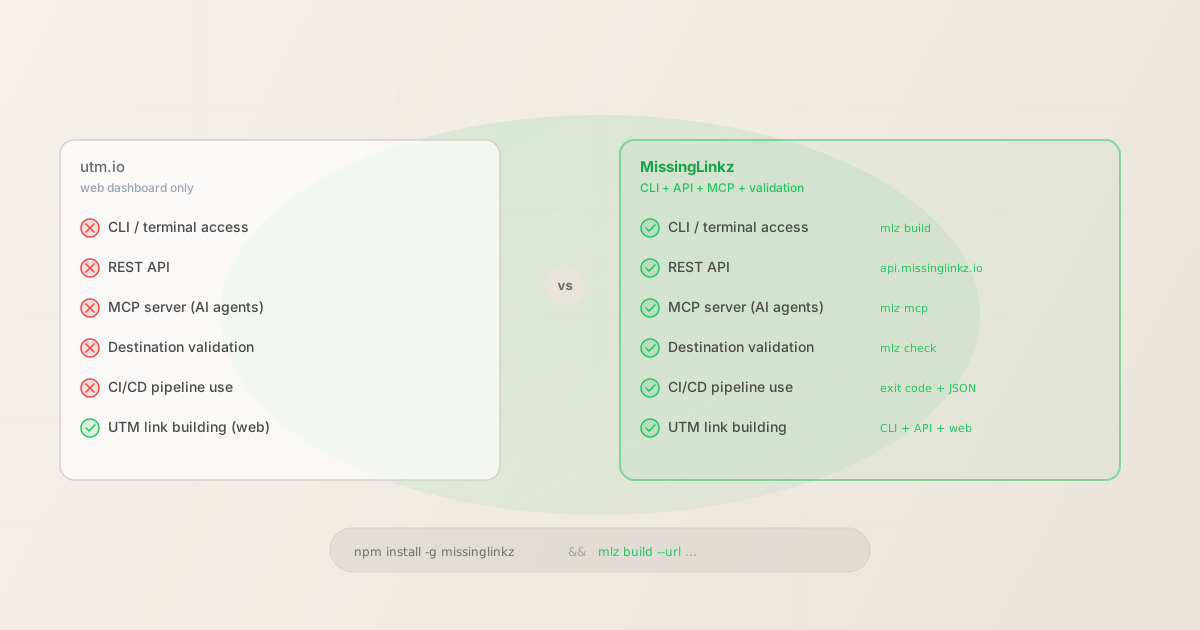
| Capability | utm.io | MissingLinkz |
|---|---|---|
| UTM link building | ✓ Web dashboard | ✓ CLI + API + web |
| CLI access | ✗ Not available | ✓ mlz build |
| REST API | ✗ No public API | ✓ api.missinglinkz.io |
| MCP server (AI agents) | ✗ Not available | ✓ mlz mcp |
| Destination validation | ✗ None | ✓ SSL, resolution, redirects |
| OG tag / social preview check | ✗ None | ✓ mlz inspect |
| CI/CD pipeline integration | ✗ Not possible | ✓ Exit code + JSON output |
| Structured JSON output | ✗ None | ✓ Every command |
| Offline UTM generation | ✗ Requires internet + browser | ✓ No API key needed |
| Free plan | ✓ Available | ✓ 1,000 links/month |
The comparison above reflects the tools as they exist today. utm.io has announced no public roadmap for CLI or API access. For the validation comparison that covers Google's Campaign URL Builder and UTM.io side-by-side, see the mlz preflight vs. other tools breakdown.
What the MissingLinkz CLI looks like in practice
Install once and generate links immediately:
npm install -g missinglinkz
mlz build --url "https://acme.com/landing" --campaign "q2-launch" --source "linkedin" --medium "social"
Output:
{
  "tracked_url": "https://acme.com/landing?utm_source=linkedin&utm_medium=social&utm_campaign=q2-launch",
  "params": {
    "utm_source": "linkedin",
    "utm_medium": "social",
    "utm_campaign": "q2-launch"
  },
  "destination_url": "https://acme.com/landing",
  "created_at": "2026-04-16T09:14:22.010Z",
  "link_id": "lnk_9wlvd9qi",
  "stored": true
}
No browser. No form. Structured JSON you can parse in any script. To also validate the destination URL, add --validate. To check OG tags and social preview readiness, use mlz inspect. For the full breakdown of programmatic UTM building patterns, see the programmatic UTM link building guide.
Destination validation: what utm.io skips
Generating a correctly formatted UTM URL does not guarantee the link works. The destination might be a 404. The redirect chain might strip the UTM parameters before GA4 records the session. The landing page might be missing OG tags, causing blank social previews when the link is shared.
utm.io does none of these checks. mlz check covers the URL health layer:
mlz check "https://acme.com/landing"
{
  "url": "https://acme.com/landing",
  "valid": true,
  "checks": [
    { "check": "url_format", "status": "pass", "message": "URL format is valid." },
    { "check": "ssl", "status": "pass", "message": "URL uses HTTPS." },
    { "check": "resolution", "status": "pass", "message": "Destination responded with 200.", "details": { "status_code": 200, "response_time_ms": 207 } },
    { "check": "redirects", "status": "pass", "message": "No redirects detected." }
  ],
  "status_code": 200,
  "response_time_ms": 207
}
Run mlz check before or after building a link, or use mlz build --validate to gate link generation on destination health. The exit code is non-zero on failure, making it safe to use in CI pipelines.
When to stick with utm.io
utm.io is the right tool if your team's workflow is entirely manual and browser-based. A marketing manager who creates links one at a time through a web form, needs the organization and team-sharing features a dashboard provides, and has no need for scripts or agent integration is well-served by utm.io.
MissingLinkz is the right choice when any of these are true:
- You need to generate links from scripts, CI jobs, or cron tasks
- You want to validate destination URLs programmatically before a campaign goes live
- You are giving an AI agent (Claude Code, Cursor, or similar) access to UTM tooling
- You want OG tag and social preview validation as part of the same workflow
- You need JSON output you can parse in code
Both tools can coexist. Teams sometimes use utm.io for marketer-facing link management and MissingLinkz for the programmatic validation layer that runs before links are deployed. The tools solve different parts of the same problem.
FAQ
- Does MissingLinkz have a web dashboard like utm.io?
- MissingLinkz provides a web UTM builder for one-off link generation, but the product's primary interface is the CLI and API. The web tool is there for marketers who prefer a form; the CLI and API are there for developers who need programmatic access. utm.io inverts this — the dashboard is primary, the API does not exist.
- Is there a free plan?
- Yes. MissingLinkz's free plan includes 1,000 links/month with no credit card required. UTM generation works offline without any account — just install the CLI and run
mlz build. An account is only needed for link storage, campaign history, and usage tracking. - Can I migrate links from utm.io?
- UTM links are just URLs with query parameters — there is nothing to migrate from the link data itself. If you have stored campaign metadata in utm.io, export it and use the MissingLinkz CLI or API to rebuild the links programmatically. A shell script reading from a CSV can batch-generate all your tracked URLs in one run.
- How does MissingLinkz compare to Google's Campaign URL Builder?
- Google's Campaign URL Builder is a web form with no API, no CLI, and no validation. It is functionally similar to utm.io in its constraints — see the full rundown of Google Campaign URL Builder alternatives for the CLI and API options. For a direct feature comparison, see the mlz preflight vs. other tools article.
Recommended posts
Try the utm.io alternative built for developers
Install MissingLinkz and build your first UTM link from the terminal in under 30 seconds. CLI, REST API, and MCP server — no browser required.
1,000 links/month free. No credit card.
Your API key
Save this now — it won't be shown again.
npm install -g missinglinkz
Free plan: 1,000 links/month. No credit card. See all commands in the SKILL.md reference.